 Add to Chrome
 Add to Firefox
 Add to Edge
FlowSeg: Dynamic Semantic Guidance for LLM-Conditioned Segmentation
May 28, 2026
LLM-conditioned segmentation has recently advanced rapidly by coupling large language models with iterative mask generation frameworks. However, we identify a persistent failure mode in current propose-then-select pipelines. Although high-quality mask candidates are often generated, the final prediction may fail to match the given linguistic condition. This failure arises because language semantics are typically used as static prompts or post-hoc matching signals, rather than participating in the iterative mask generation process. Through systematic analysis, we show that many errors stem from semantic misalignment rather than poor mask quality. To address this issue, we propose FlowSeg, which introduces dynamic semantic guidance via a bidirectional semantic flow between intermediate decoding states and LLM-derived condition embeddings throughout the generation process. Language conditions actively guide mask refinement at each stage, while condition embeddings are progressively updated by emerging visual evidence. This design yields semantically grounded mask representations and visually aligned language conditions, enabling more reliable matching. We further incorporate a lightweight boundary-aware refinement to selectively enhance uncertain regions without perturbing confident interiors. Extensive experiments on referring expression segmentation and reasoning segmentation tasks demonstrate that FlowSeg consistently improves language-mask alignment and achieves state-of-the-art performance. Project page: https://zkzhang98.github.io/FlowSeg_page

MiVE: Multiscale Vision-language features for reference-guided video Editing
May 14, 2026Reference-guided video editing takes a source video, a text instruction, and a reference image as inputs, requiring the model to faithfully apply the instructed edits while preserving original motion and unedited content. Existing methods fall into two paradigms, each with inherent limitations: decoupled encoders suffer from modality gaps when processing instructions and visual content independently, while unified vision-language encoders lose fine-grained spatial details by relying solely on final-layer representations. We observe that VLM layers encode complementary information hierarchically -- early layers capture localized spatial details essential for precise editing, while deeper layers encode global semantics for instruction comprehension. Building on this insight, we present MiVE (Multiscale Vision-language features for reference-guided video Editing), a framework that repurposes VLMs as multiscale feature extractors. MiVE extracts hierarchical features from Qwen3-VL and integrates them into a unified self-attention Diffusion Transformer, eliminating the modality mismatch inherent in cross-attention designs. Experiments demonstrate that MiVE achieves state-of-the-art performance by ranking highest in human preference, outperforming both academic methods and commercial systems.
PortraitCraft: A Benchmark for Portrait Composition Understanding and Generation
Apr 04, 2026Portrait composition plays a central role in portrait aesthetics and visual communication, yet existing datasets and benchmarks mainly focus on coarse aesthetic scoring, generic image aesthetics, or unconstrained portrait generation. This limits systematic research on structured portrait composition analysis and controllable portrait generation under explicit composition requirements. In this paper, we introduce PortraitCraft, a unified benchmark for portrait composition understanding and generation. PortraitCraft is built on a dataset of approximately 50,000 curated real portrait images with structured multi-level supervision, including global composition scores, annotations over 13 composition attributes, attribute-level explanation texts, visual question answering pairs, and composition-oriented textual descriptions for generation. Based on this dataset, we establish two complementary benchmark tasks for composition understanding and composition-aware generation within a unified framework. The first evaluates portrait composition understanding through score prediction, fine-grained attribute reasoning, and image-grounded visual question answering, while the second evaluates portrait generation from structured composition descriptions under explicit composition constraints. We further define standardized evaluation protocols and provide reference baseline results with representative multimodal models. PortraitCraft provides a comprehensive benchmark for future research on fine-grained portrait understanding, interpretable aesthetic assessment, and controllable portrait generation.
Context Tokens are Anchors: Understanding the Repetition Curse in dMLLMs from an Information Flow Perspective
Jan 28, 2026Recent diffusion-based Multimodal Large Language Models (dMLLMs) suffer from high inference latency and therefore rely on caching techniques to accelerate decoding. However, the application of cache mechanisms often introduces undesirable repetitive text generation, a phenomenon we term the \textbf{Repeat Curse}. To better investigate underlying mechanism behind this issue, we analyze repetition generation through the lens of information flow. Our work reveals three key findings: (1) context tokens aggregate semantic information as anchors and guide the final predictions; (2) as information propagates across layers, the entropy of context tokens converges in deeper layers, reflecting the model's growing prediction certainty; (3) Repetition is typically linked to disruptions in the information flow of context tokens and to the inability of their entropy to converge in deeper layers. Based on these insights, we present \textbf{CoTA}, a plug-and-play method for mitigating repetition. CoTA enhances the attention of context tokens to preserve intrinsic information flow patterns, while introducing a penalty term to the confidence score during decoding to avoid outputs driven by uncertain context tokens. With extensive experiments, CoTA demonstrates significant effectiveness in alleviating repetition and achieves consistent performance improvements on general tasks. Code is available at https://github.com/ErikZ719/CoTA
Learning Stochastic Bridges for Video Object Removal via Video-to-Video Translation
Jan 17, 2026Existing video object removal methods predominantly rely on diffusion models following a noise-to-data paradigm, where generation starts from uninformative Gaussian noise. This approach discards the rich structural and contextual priors present in the original input video. Consequently, such methods often lack sufficient guidance, leading to incomplete object erasure or the synthesis of implausible content that conflicts with the scene's physical logic. In this paper, we reformulate video object removal as a video-to-video translation task via a stochastic bridge model. Unlike noise-initialized methods, our framework establishes a direct stochastic path from the source video (with objects) to the target video (objects removed). This bridge formulation effectively leverages the input video as a strong structural prior, guiding the model to perform precise removal while ensuring that the filled regions are logically consistent with the surrounding environment. To address the trade-off where strong bridge priors hinder the removal of large objects, we propose a novel adaptive mask modulation strategy. This mechanism dynamically modulates input embeddings based on mask characteristics, balancing background fidelity with generative flexibility. Extensive experiments demonstrate that our approach significantly outperforms existing methods in both visual quality and temporal consistency.
On Exact Editing of Flow-Based Diffusion Models
Dec 30, 2025Recent methods in flow-based diffusion editing have enabled direct transformations between source and target image distribution without explicit inversion. However, the latent trajectories in these methods often exhibit accumulated velocity errors, leading to semantic inconsistency and loss of structural fidelity. We propose Conditioned Velocity Correction (CVC), a principled framework that reformulates flow-based editing as a distribution transformation problem driven by a known source prior. CVC rethinks the role of velocity in inter-distribution transformation by introducing a dual-perspective velocity conversion mechanism. This mechanism explicitly decomposes the latent evolution into two components: a structure-preserving branch that remains consistent with the source trajectory, and a semantically-guided branch that drives a controlled deviation toward the target distribution. The conditional velocity field exhibits an absolute velocity error relative to the true underlying distribution trajectory, which inherently introduces potential instability and trajectory drift in the latent space. To address this quantifiable deviation and maintain fidelity to the true flow, we apply a posterior-consistent update to the resulting conditional velocity field. This update is derived from Empirical Bayes Inference and Tweedie correction, which ensures a mathematically grounded error compensation over time. Our method yields stable and interpretable latent dynamics, achieving faithful reconstruction alongside smooth local semantic conversion. Comprehensive experiments demonstrate that CVC consistently achieves superior fidelity, better semantic alignment, and more reliable editing behavior across diverse tasks.
AlignGen: Boosting Personalized Image Generation with Cross-Modality Prior Alignment
May 28, 2025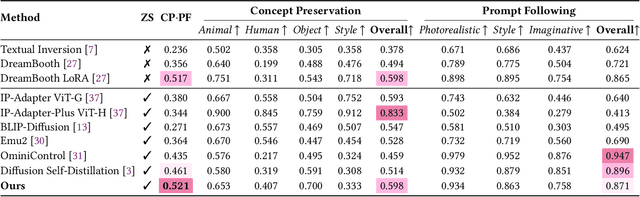
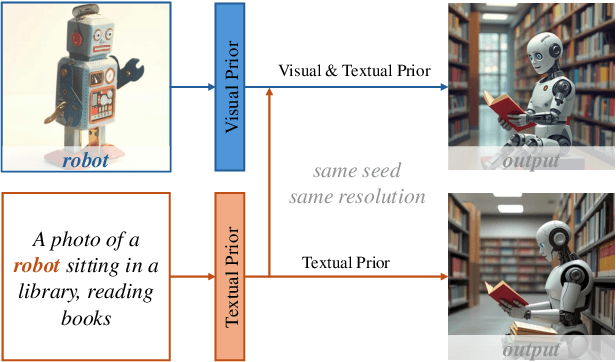
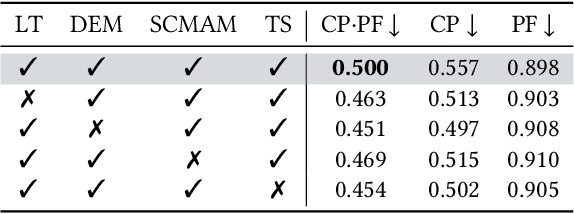
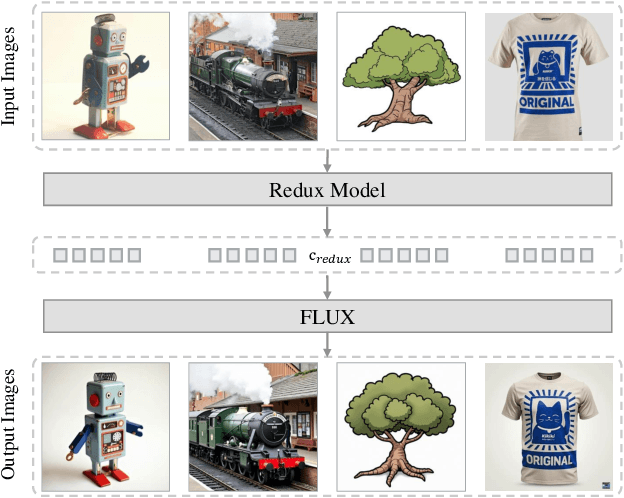
Personalized image generation aims to integrate user-provided concepts into text-to-image models, enabling the generation of customized content based on a given prompt. Recent zero-shot approaches, particularly those leveraging diffusion transformers, incorporate reference image information through multi-modal attention mechanism. This integration allows the generated output to be influenced by both the textual prior from the prompt and the visual prior from the reference image. However, we observe that when the prompt and reference image are misaligned, the generated results exhibit a stronger bias toward the textual prior, leading to a significant loss of reference content. To address this issue, we propose AlignGen, a Cross-Modality Prior Alignment mechanism that enhances personalized image generation by: 1) introducing a learnable token to bridge the gap between the textual and visual priors, 2) incorporating a robust training strategy to ensure proper prior alignment, and 3) employing a selective cross-modal attention mask within the multi-modal attention mechanism to further align the priors. Experimental results demonstrate that AlignGen outperforms existing zero-shot methods and even surpasses popular test-time optimization approaches.
GlyphMastero: A Glyph Encoder for High-Fidelity Scene Text Editing
May 08, 2025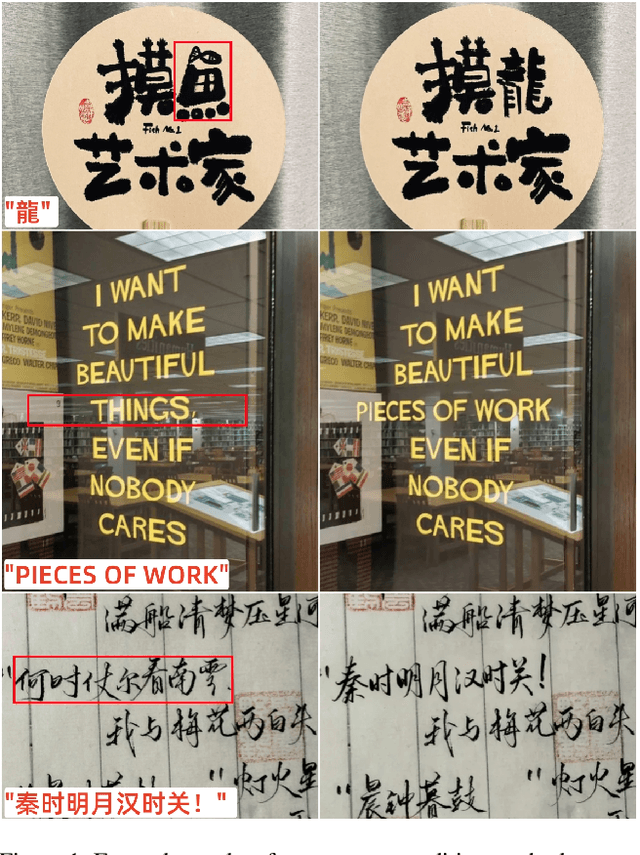
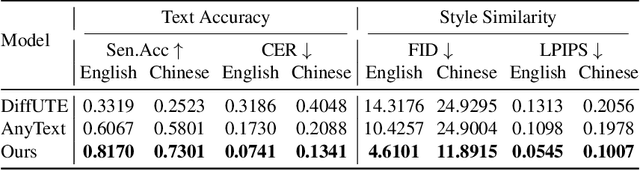
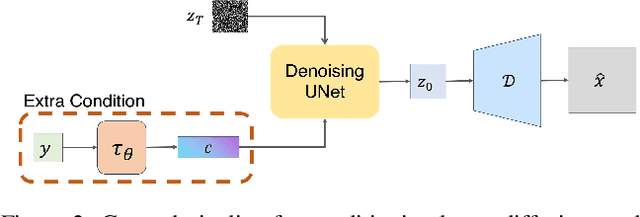
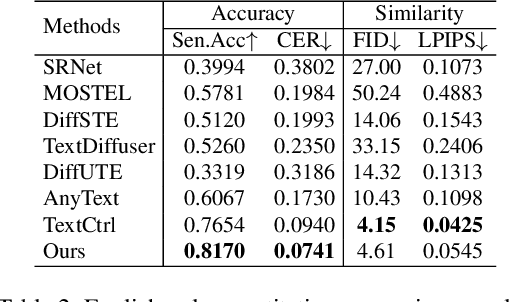
Scene text editing, a subfield of image editing, requires modifying texts in images while preserving style consistency and visual coherence with the surrounding environment. While diffusion-based methods have shown promise in text generation, they still struggle to produce high-quality results. These methods often generate distorted or unrecognizable characters, particularly when dealing with complex characters like Chinese. In such systems, characters are composed of intricate stroke patterns and spatial relationships that must be precisely maintained. We present GlyphMastero, a specialized glyph encoder designed to guide the latent diffusion model for generating texts with stroke-level precision. Our key insight is that existing methods, despite using pretrained OCR models for feature extraction, fail to capture the hierarchical nature of text structures - from individual strokes to stroke-level interactions to overall character-level structure. To address this, our glyph encoder explicitly models and captures the cross-level interactions between local-level individual characters and global-level text lines through our novel glyph attention module. Meanwhile, our model implements a feature pyramid network to fuse the multi-scale OCR backbone features at the global-level. Through these cross-level and multi-scale fusions, we obtain more detailed glyph-aware guidance, enabling precise control over the scene text generation process. Our method achieves an 18.02\% improvement in sentence accuracy over the state-of-the-art multi-lingual scene text editing baseline, while simultaneously reducing the text-region Fr\'echet inception distance by 53.28\%.
DCEdit: Dual-Level Controlled Image Editing via Precisely Localized Semantics
Mar 21, 2025This paper presents a novel approach to improving text-guided image editing using diffusion-based models. Text-guided image editing task poses key challenge of precisly locate and edit the target semantic, and previous methods fall shorts in this aspect. Our method introduces a Precise Semantic Localization strategy that leverages visual and textual self-attention to enhance the cross-attention map, which can serve as a regional cues to improve editing performance. Then we propose a Dual-Level Control mechanism for incorporating regional cues at both feature and latent levels, offering fine-grained control for more precise edits. To fully compare our methods with other DiT-based approaches, we construct the RW-800 benchmark, featuring high resolution images, long descriptive texts, real-world images, and a new text editing task. Experimental results on the popular PIE-Bench and RW-800 benchmarks demonstrate the superior performance of our approach in preserving background and providing accurate edits.
Memory Efficient Matting with Adaptive Token Routing
Dec 17, 2024

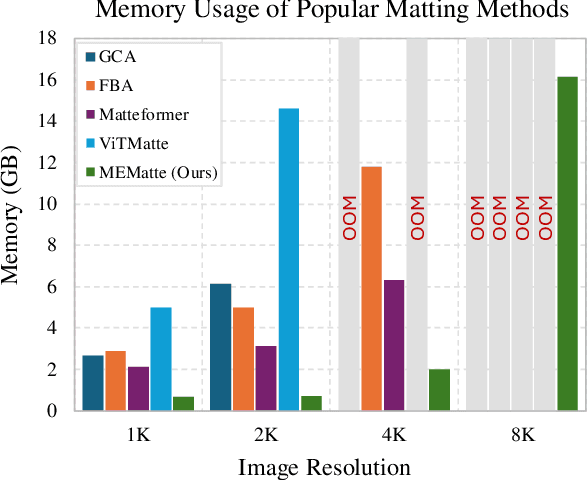

Transformer-based models have recently achieved outstanding performance in image matting. However, their application to high-resolution images remains challenging due to the quadratic complexity of global self-attention. To address this issue, we propose MEMatte, a \textbf{m}emory-\textbf{e}fficient \textbf{m}atting framework for processing high-resolution images. MEMatte incorporates a router before each global attention block, directing informative tokens to the global attention while routing other tokens to a Lightweight Token Refinement Module (LTRM). Specifically, the router employs a local-global strategy to predict the routing probability of each token, and the LTRM utilizes efficient modules to simulate global attention. Additionally, we introduce a Batch-constrained Adaptive Token Routing (BATR) mechanism, which allows each router to dynamically route tokens based on image content and the stages of attention block in the network. Furthermore, we construct an ultra high-resolution image matting dataset, UHR-395, comprising 35,500 training images and 1,000 test images, with an average resolution of $4872\times6017$. This dataset is created by compositing 395 different alpha mattes across 11 categories onto various backgrounds, all with high-quality manual annotation. Extensive experiments demonstrate that MEMatte outperforms existing methods on both high-resolution and real-world datasets, significantly reducing memory usage by approximately 88% and latency by 50% on the Composition-1K benchmark. Our code is available at https://github.com/linyiheng123/MEMatte.